
Views: 0 Author: Site Editor Publish Time: 2026-03-10 Origin: Site


Challenge coins carry weight—literally and symbolically. These small, metal tokens have represented honor, belonging, and achievement for over a century, tracing their roots back to military units in World War I. Back then, a coin bearing your unit's insignia could save your life; today, a custom challenge coin can commemorate a company milestone, celebrate a sports team, or mark a once-in-a-lifetime event.
The tradition has expanded well beyond the military. Corporations, nonprofits, fire departments, police forces, and even individual collectors now order custom challenge coins to recognize achievements or commemorate special moments. If you've been thinking about designing your own, the process is more accessible—and more creative—than you might expect.
This guide walks you through every key decision, from choosing your material to finalizing your finish, so you can design a challenge coin that's built to last and meaningful to whoever holds it.
A challenge coin is a small, medallion-style token—typically between 1.5" and 3" in diameter—bearing a symbol, logo, or design that represents a group, event, or achievement. Unlike a generic trophy or certificate, a well-designed challenge coin is something people carry with them. That's what makes the design so important.
A strong challenge coin design is immediately recognizable, visually balanced on both sides, and meaningful to its recipient. A weak one gets lost in a drawer. The difference often comes down to the decisions you make before the coin ever goes into production.
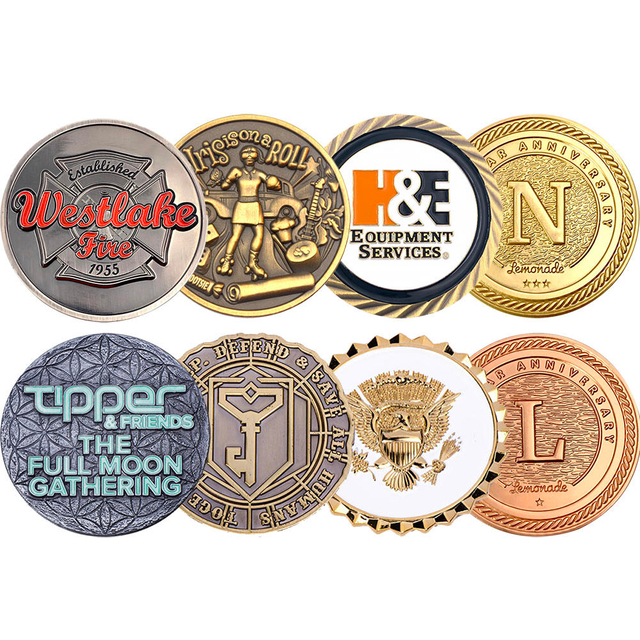
Most challenge coins follow a standard circular format, but the shape is entirely up to you. Polygons, shields, dog tag shapes, and custom cutouts are all achievable through modern manufacturing techniques like die casting and die striking.
For sizing, here's a quick reference:
Size | Best For |
|---|---|
1.5" | Minimalist designs, small organizations |
1.75" | Standard military-style coins |
2" | Most popular all-purpose size |
2.25"–2.5" | Complex designs with lots of detail |
3" | Display pieces, commemorative coins |
Thickness also plays a role in how premium the coin feels. Options typically range from 2mm to 6mm. A thicker coin feels more substantial and prestigious—something worth keeping in mind if your coin is intended as a meaningful gift or award.
The material you choose affects both the appearance and the durability of your coin. Common options include:
Brass – The most traditional material. Durable, easy to engrave, and takes plating beautifully.
Copper – Warm-toned and classic. Often used for antique-style finishes.
Zinc alloy – A cost-effective option that works well for high-volume orders.
Iron – Budget-friendly and sturdy, best suited for simpler designs.
Aluminum – Lightweight and affordable, ideal for casual or promotional coins.
For collectors and commemorative purposes, brass and copper tend to hold their quality the longest and age gracefully over time.
The plating is what gives your coin its final appearance. This is one of the most impactful design decisions you'll make, as it determines the coin's overall tone and feel.
Finish Type | Options Available |
|---|---|
Shiny | Gold, Silver, Nickel, Copper, Brass |
Antique | Antique Gold, Antique Silver, Antique Copper, Antique Brass |
Shiny finishes give your coin a polished, modern look. Antique finishes create depth and texture by leaving recessed areas darker, which makes raised design elements pop. For military-style or heritage-themed coins, antique finishes are a natural fit. For corporate or event coins, a shiny gold or silver finish tends to read as more prestigious.
Color brings a design to life. When you make challenge coins with painted detail, you have three main options:
Soft Enamel – Color fills sit slightly below the metal edges, creating a tactile, textured feel. This is the most popular choice and gives coins a classic look.
Imitation Hard Enamel – Produces a smoother, flatter surface that mimics the high-end look of true hard enamel at a lower cost.
Poly Enamel – A printed image is sealed under a clear resin dome. Great for photographic-quality designs or highly detailed artwork.
You can also add an epoxy coating over the top of your design for extra protection and a glossy finish—particularly useful for coins that will be handled frequently.

This is where many people feel stuck—but it doesn't need to be complicated. Here's a simple framework for developing your challenge coin design:
Ask yourself what this coin represents. A military unit coin will have very different visual language than a corporate anniversary coin. Clarity on purpose drives every design choice that follows.
List the symbols, text, and imagery that must appear on the coin. Common elements include:
A central logo or emblem
Organization name
Founding year or event date
Motto or tagline
Border or edge details
Most challenge coins feature a front (obverse) and a back (reverse). Use one side for the primary design and the other for secondary information, complementary imagery, or a motto.
A 2" coin is small. Detailed text and fine lines can get lost during production. Aim for bold, clean artwork with high contrast between the raised elements and the background.
Professional manufacturers like Hugoway will generate a 2D proof within approximately 7 days of receiving confirmed artwork, or a 3D design proof within 10 days. Review these carefully before approving production.
Understanding the production timeline helps you plan realistically—especially if your coin is tied to a specific event or deadline.
Stage | Timeframe |
|---|---|
Artwork confirmation | Client-dependent |
2D sample production | ~7 days after artwork confirmed |
3D sample production | ~10 days after artwork confirmed |
Lead time (post-sample approval) | 12–20 days |
Shipping (air express) | Varies by destination |
One significant advantage of working with manufacturers like Hugoway is that there is no minimum order quantity (MOQ). This means you can order a small run for a single team or event without committing to hundreds of units.
How you present a coin matters, especially if it's being given as an award or gift. Standard packaging options include:
Poly bag (simple and cost-effective)
PVC pouch
OPP bag
Plastic display box
Velvet pouch (premium feel, ideal for awards)
For a coin meant to mark something significant, a velvet pouch or plastic display box elevates the unboxing experience and signals that this is something worth keeping.
Yes. Most manufacturers provide design support and will work from a rough sketch, a logo file, or even a written description. You don't need professional design software to get started.
Pricing varies based on size, material, plating, paint complexity, and quantity. Because there's typically no minimum order, you can request a quote for any volume—from a single sample to a large batch.
Most manufacturers prefer vector files (AI, EPS, or PDF) for the cleanest results. High-resolution PNG or JPG files are often acceptable for simpler designs, but vector formats give the manufacturer the most flexibility.
Yes, particularly those made from brass or copper. The metal construction, combined with quality plating and an optional epoxy coating, makes them highly resistant to everyday wear.
Absolutely. Custom shapes—including shields, stars, polygons, and fully custom cutouts—are achievable through die casting and die striking processes.
The difference between a forgettable token and a coin someone carries for decades comes down to intentional design. Start with a clear purpose, choose materials and finishes that match the tone you're going for, and work with a manufacturer that offers proofs and flexible order quantities.
Whether you're creating a commemorative piece for a military unit, a corporate milestone, or a personal collection, the right manufacturer makes the process straightforward from artwork to delivery. Explore Hugoway's custom challenge coin options to get started with a free design and no minimum order requirement.